Regenerative transformation (Moving beyond the sustainability mirage)
Conventional sustainability strategies haven’t stopped the “permacrisis.” Regeneration doesn’t aim to slow decline—it aims to restore what makes the economy possible: the commons.
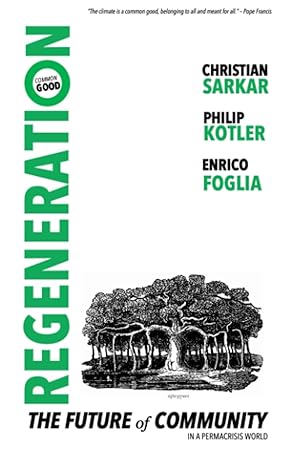
Regeneration : The future of Community in a Permacrisis World, by Christian Sarkar, Philip Kotler and Enrico Foglia, Idea Bite Press 2023.
Regeneration offers a different logic: not to slow decline, but to restore what makes the economy possible—the commons. Fertile soil, clean water, a stable community, a baseline of social trust: that’s vital capital. A regenerative company is defined by its ability to strengthen these foundations. This is a strategic project, not a feel-good add-on. Leaders who adopt it build more resilient value chains, attract talent, and earn the “social license” to operate that’s essential in an unstable world.
1 . Structure your strategic thinking (to break free from the extractive model)
The first shift is acknowledging that the dominant model—maximizing shareholder return while externalizing social and ecological costs—has hit its limit. How do we move from an extractive logic to a generative one, creating value while making ecosystems stronger?
Refocus value creation.
A regenerative company doesn’t just optimize EBITDA; it also measures the community wealth it leaves behind.
Dutch insurer Achmea, for example, is relocalizing services and investing in preventive health to diminish accidents and social costs.
Internalize hidden costs.
Carbon pricing isn’t enough; you need to build the true value of water, soil, and human labor into internal prices.
Finnish textile group Spinnova bills its internal units using near-zero-impact fibers as the benchmark, forcing real economic trade-offs.
Relocalize smartly.
Shortening certain supply chains secures raw materials and know-how.
The chocolatier Original Beans, based in Europe, pays cocoa-growing communities directly by funding reforestation that stabilizes its supply chains.
Support regenerative innovation.
Iceland’s Carbfix mineralizes CO₂ in basalt; France’s Ÿnsect industrializes insect protein to avoid soy-linked deforestation; energy group Iberdrola co-develops renewable microgrids with local communities.
Measure differently.
Measuring performance differently is now critical. It’s not just about tracking carbon: you need tools that make social impact, ecosystem health, and local trust visible—such as a Net Regenerative Score or Impact-Weighted Accounts—to track not only carbon but also ecosystem restoration and social cohesion.
Italy’s Chiesi Farmaceutici already publishes an integrated carbon-plus-social report.
Cooperate beyond competition.
Denmark’s Ørsted and several rival utilities share offshore infrastructure to boost offshore wind production; automakers are shifting to recyclable-battery consortia (Northvolt, ACC) instead of investing solo.
2. Be clear about what you intend to do (and about the processes to execute)
Regeneration doesn’t go anywhere without an instruction manual: you need a simple grammar the frontline can own. The PRIT frame—Protect, Repair, Invest, Transform—sets the pace: secure the essentials, fix the past, steer capital, then refound governance to anchor the long term.
Protect
Protecting means securing vital assets now: the natural resources that sustain your business, the human know-how at risk of disappearing, and the communities your suppliers and customers come from.
French glassmaker Verallia, for example, reworked the management of its sand quarries with local authorities and funds the preservation of groundwater tables.
Repair
Repair is the second step: acknowledge inherited damage and fix it. Interface, the carpet pioneer, has invested for years to remove polluting nylon from old products and clean up marine dumps
L’Oréal commits to regenerating the watersheds affected by the cultivation of the cosmetic ingredients it uses.
Invest
Investing means committing capital to high-impact regenerative projects: training, infrastructure, research, and more.
Schneider Electric, for example, dedicates part of its innovation fund to sustainable rural electrification—deepening its roots in emerging markets.
Transform
Transforming means changing governance and economic incentives themselves to break out of short-termism.
Switzerland’s Holcim—long a symbol of polluting cement—has launched low-carbon concrete lines and tied part of its executive pay to those targets.
3. Be clear about how to do it (Run a five-point method)
Regeneration only counts in execution: enough slogans, time for action in the field. For you, that means rooting action in place, diagnosing real dependencies, co-designing with stakeholders, prototyping fast, and measuring what matters.
Diagnose from the territory.
A solid regenerative approach starts with a place-based diagnosis. Instead of abstract KPIs, you need to map real dependencies: where the company draws resources, who depends on it, and which social or ecological vulnerabilities it strains.
Decathlon now runs these analyses before opening a new site, adjusting store concept and local partnerships accordingly.
Engage stakeholders.
Top-down strategies are over. Co-construction with stakeholders is now essential. Create a space where employees, suppliers, residents, and local authorities take part.
Carlsberg worked with farmers to develop barley more resilient to climate change—securing the beer of the future.
Build entrepreneurial ecosystems.
Italian company Novamont creates territorial biochemistry hubs, bringing together SMEs, farmers, and labs to develop compostable plastics while revitalizing rural economies.
Local entrepreneurial ecosystems follow naturally.
But this only works if you avoid “green gentrification”: regeneration is done with communities, not against them. You rehabilitate without excluding.
London’s Community Food Growers cooperative secures land for urban market gardeners instead of letting speculation follow so-called “sustainable redevelopment.”
Establish trust indicators.
Trust must be measured and cultivated. Accessible impact reports, independent audits, and multi-stakeholder committees help avoid being suspected of greenwashing.
Triodos Bank, for example, publishes a detailed report linking every euro invested to its ecological and social effects.
Prototype and learn fast.
Pilot projects (e.g., internal circular economy), measure, adjust.
You must learn by doing. Instead of perfect plans, launch pilots and prototypes (for example, an internal circular economy), evaluate, iterate. This pragmatism makes regeneration credible and measurable.
IKEA began by quietly testing furniture buy-back and resale before rolling out the second-life offer globally.
4. …And drop the cult of the hero (who thinks they can save everyone)
Regeneration isn’t declared; it’s embodied. Systemic transformations fail if everything rests on one charismatic leader. Drop the lone-hero myth and build a community of leadership.
John Lewis, the UK retailer owned by its employees, shows that shared power can sustain a long-term strategy without abrupt breaks or loss of agility
At the center, a clear mission: serve the common good. Employees—especially younger ones—want to know how their work improves a place, restores soil, and protects resources. Without that clarity, engagement erodes and talent leaves.
Practice institutional courage.
Institutional courage is now central: acknowledge blind spots and accept the cost of change.
Ørsted, once a coal champion, publicly committed to a full exit from fossil fuels even before it had a definitive technical roadmap. That deliberate bet strengthened the internal and external credibility of its transformation.
Align long-term vision and incentives.
Your incentive system must follow, with impact metrics built into bonuses. Without aligned compensation, regenerative talk is wishful thinking.
DSM in the Netherlands ties executives’ variable pay to environmental and nutritional impact targets.
Develop new skills.
Leadership must open up to new competencies: systems thinking, the ability to work with diverse actors, and emotional intelligence to navigate uncertainty and societal conflict.
Philips’s training programs now include modules on the circular economy and climate justice.
Think in five worlds
(always)
A regenerative company doesn’t act in a vacuum. It operates across five interlocking spheres. First, the individual: each employee must understand their role and find meaning in it. Second, the community: the company roots itself, invests, and maintains trust. Third, the organization: its business model becomes circular, lean, and fair. Fourth, the nation: it advocates for policies that favor the long term and justice over social or environmental dumping. Finally, the planet: it measures its global footprint and actively helps restore living systems.
This multi-level approach is what turns regeneration into a lasting strategy. It avoids cosmetic greening and builds real legitimacy. Companies that take this path don’t just survive the permacrisis; they build relevance, attractiveness, and—paradoxically—economic strength. In a wavering world, they become fixed points—because they regenerate what makes all prosperity possible.
© Copyright Business Digest - All rights reserved