Rereading Arendt : Thinking again in the face of the void
Totalitarianism isn’t dead. It’s been digitized, streamlined and normalized. It’s back not in boots, but in interfaces. As long as we scroll more than we think, history will keep repeating itself—sanitized, maybe, but no less brutal. In an age where governance is mistaken for obedience, rereading Arendt is an act of resistance. Either we engage our minds… or we let the void think for us.
Our contradictions on climate change
Do you think that totalitarianism is a relic of the past? That it’s just a nightmare from the 20th century? Well, think again. Hannah Arendt didn’t write The Origins of Totalitarianism for historians; she wrote it for those of us who refuse to sleepwalk through history. What she unpacks isn’t just a political regime—it’s a machinery for destroying thought, a cold, rational logic that’s resurfacing today in softer, more technological forms, but just as corrosive. Rereading Arendt isn’t about revisiting a bygone past: it’s about confronting a present that’s falling apart around us.
The work of Hannah Arendt The Origins of Totalitarianism (1951), Between Past and Future (The Crisis in Culture, 1961) as well as The Age of Surveillance Capitalism by Shoshana Zuboff (PublicAffairs, 2019), and Resonance: A Sociology of Our Relationship to the World by Hartmut Rosa and James Wagner (Polity 2019).
1. The void as foundation
Totalitarianism doesn’t grow on fertile ground: it thrives in wasteland. Not the wasteland left behind by war or material collapse, but a more insidious kind of disconnection, apathy, and disenchantment. Arendt saw this clearly: it’s not poverty that makes people susceptible to horror, but the loss of a shared world. When words lose their meaning, when facts become negotiable, when nothing connects people except fear or distrust—that’s when the ground is ready.
The isolated citizen no longer has a story of their own. They lose faith in politics, distrust institutions, and no longer believe in others—or themselves. They stop seeking to understand: they want to belong. To be taken care of. To dissolve into a cause that gives them back a sense of place in the world. That longing for fusion, that existential panic in the face of chaos—that’s what totalitarianism feeds on. It offers a total explanation, the illusion of clarity, the comfort of coherence.
And today? Nothing has changed. We’re flooded with tools for communicating, but starved of a shared language. The modern citizen walks alone through a world where everything is relative, where every opinion masquerades as truth, and nuance is seen as treachery. Institutions feel distant or corrupt. Reality is a stream, words are unstable, emotions replace facts. It’s not that we no longer know what’s true; it’s that we’ve stopped even trying to find out.
In this climate, the return of the totalizing narrative, the simplistic answer, the unifying storyline becomes tempting… deeply tempting. That’s the real danger: when the void craves to be filled, and what fills it is an authoritarian ideology—rational on the surface, brutal underneath.
Arendt was right: totalitarianism does not arise from chaos—it seeps in through silence. It doesn’t take over by force, but through exhaustion. Through surrender.
2. Ideology 2.0 : The new religion
What totalitarianism demands, above all, is an idea to worship. A simple, uncompromising idea that is immune to contradiction. For Arendt, ideology isn’t a political theory—it’s a self-contained narrative that claims to explain everything, from past to future, by eliminating uncertainty, doubt, and freedom. Ideology is the fantasy of perfect order in a complex world—and that’s exactly what makes it so deadly.
In the past, the sacred idea was called “race” or “class.” Today, it wears new labels: “progress,” “carbon neutrality,” “digital transformation,” “public health,” “innovation.” The words may change, but the mechanism stays the same. It’s still about declaring a higher goal, infusing it with moral urgency, and using it to silence dissent. Who would dare slow down the green transition? Who would oppose the fight against disinformation, terrorism, or a virus? Through constant moral pressure, modern ideology creates a climate where raising objections feels suspect or even unethical.
This soft totalitarianism runs on manufactured consensus. It doesn’t need a Ministry of Propaganda, just a clever communications strategy, a few well-tuned algorithms, and a clear enemy. It doesn’t kill dissent, it drowns it out. It doesn’t burn books, it floods the space with noise until thought can no longer surface.
The power of modern ideology lies in how pragmatic it appears. Tech-friendly. It can be administered, tracked and measured. It is reassuring because it promises to manage the world instead of understanding it.
This modern ideology demands one thing in return: submission to the narrative. The abandonment of independent thought. It’s sleek, it’s connected—but it’s the same poison. Nothing has changed since Arendt’s warning.
3. Diffuse power, or the faceless state
In The Origins of Totalitarianism, Arendt shows how the state becomes an ideological tool, absorbed by the one-party system until it loses all autonomy. Today, this fusion has evolved. It’s no longer the Party giving orders—it’s the cloud. A web of fragmented powers: countless unseen actors, consulting firms, ever-present experts, automated standards, processes, and platforms. Power has been dematerialized, but its presence is everywhere.
There is no need for boots or cults of personality anymore. Discipline now comes from within: through soft conformity, constant evaluations, and daily KPIs. Companies act like states, states act like companies, and citizens become a “human resource” to be optimized. They’re listened to, surveyed, notified—but no longer treated as political actors. They’re data. Behavioral flows.
Arendt warned against bureaucracy as the breeding ground of irresponsibility. And here we are. Vital decisions are made by no single person: they emerge from layers of reports, committees, and consultants. No one gives orders, so no one can be held accountable. It’s governance by slide deck, by deflection, by infographic. Orders aren’t issued—they’re suggested by the interface.
This liquid power is particularly challenging to confront because it has no face. It slips away, whispers, disguises itself as public service or user-friendly design. But the effect is the same as totalitarian power: it strips people of their ability to act, to decide, to envision a shared future. It neutralizes politics and replaces it with management. And turns the world into one endless waiting room.
Citizens become mere users. And servitude becomes voluntary, seamless—almost a thing of beauty.
4. Thinking—To break the chain
In response to this stifling modernity, Arendt doesn’t counter with law, or morality, or even democracy as a system. She proposes something more radical: the act of thinking. Not thinking as in collecting opinions or stacking up knowledge—but thinking as in pausing, questioning, resisting the automatic. To think is to break the chain. To slow down. To push back against what seems obvious, what comes fast, what feels good. It’s saying: I’m not sure. And in a world that prizes instant reaction and immediate certainty, that is a form of disobedience.
For Arendt, the real danger isn’t malice; it’s banality. It’s the ability to commit harm without hatred, without conviction—simply because we’ve stopped thinking. Because we’re “just doing our job,” “following orders,” “trying not to make waves.” This banality of evil, embodied by Eichmann1, now permeates every automated process, every impersonal rejection, every passive act of obedience.
To think today is to reject this deadly neutrality. It means resisting the formulaic language of reports, slides, and recommendations. It means reclaiming a living language—human, messy, confrontational. It means relearning how to oppose, to debate, to doubt together. To think is to rebuild a world against the machinery of organized nothingness.
Let’s be clear: totalitarianism doesn’t need tyrants. Modern totalitarianism no longer needs camps. All it takes is a world where no one thinks anymore.
Rereading Arendt is about rejecting the dulling effects of collective conformity. It’s about lighting a light in the fog.
5. Embrace the long view (to relearn what freedom means)
So, what can we do to stay afloat? To stay clear-headed when the world urges us to surrender? It’s not about shouting over the noise or withdrawing into an ivory tower. It’s about creating, moment by moment, the conditions for inner freedom. Protecting a space within ourselves that nothing can automate or absorb. Reading slowly. Listening fully. Speaking with precision. Resisting slogans. Embracing the long view. Challenging what seems obvious. And rejecting the lazy comfort of superficial indignation.
Freedom is not something that is granted to us: it’s something we work for. It’s fragile, demanding, and crafted with care. It’s nourished by human connection, exchanging ideas, and shared memory. It sometimes requires disobedience—not out of a love for disruption, but out of loyalty to who we are: beings capable of starting anew.
Arendt didn’t believe in miracles. But she did believe in the extraordinary human capacity to bring something new into the world. “Every man, by being born, is a new beginning,” she wrote. That, perhaps, is our most powerful weapon: to resist the illusion of fate. To reject the script. To stand our ground. And to begin again—over and over—by thinking, together.
Quick look at 3 must-read books
The Origins of Totalitarianism
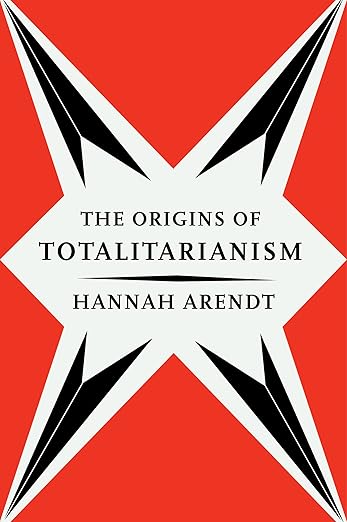
First published in 1951, this seminal work traces the rise of totalitarianism in the 20th century through three key dynamics: antisemitism, imperialism, and the mechanics of the totalitarian system. Totalitarianism doesn’t erupt from chaos—it grows out of boredom, isolation, and the desire to make sense of the world in a single sentence. In this razor-sharp classic, Arendt dissects the cold logic that turns alienated masses into accomplices to horror. There’s no need for monsters—just obedient functionaries. This isn’t a historical reminder… it’s a warning. Ideology still lurks among us; it has just learned how to wear a smile.
The Age of Surveillance Capitalism
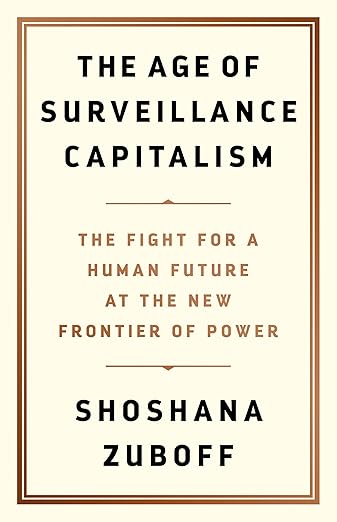
Welcome to the economy of digital violation—where your attention is harvested, your emotions decoded, and your behavior monetized—all with your conveniently pre-checked “consent.” Shoshana Zuboff exposes the inner workings of the GAFAM machine, which turns human experience into predictive raw material. You’re no longer using Google—Google is using you. Behind the promise of convenience lies a form of capitalism that infiltrates the most intimate parts of our lives. What if algorithms are the new totalitarianism? This book offers a searing critique of digital capitalism and the transformation of citizens into data. It is essential reading for understanding how algorithmic governance and the erasure of the thinking individual go hand in hand today.
Resonance: A Sociology of Our Relationship to the World
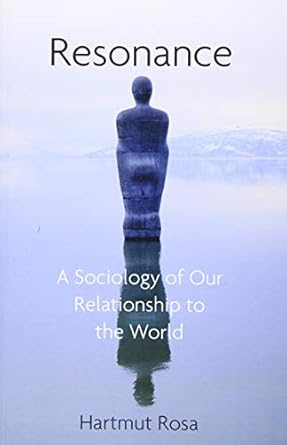
The disenchantment of modern life, Rosa argues, comes from our inability to “resonate” with the world—a powerful contemporary echo of Arendt’s idea of losing a shared reality. What if the real modern illness isn’t the noise, but the silence of a world that no longer answers us? Rosa dismantles the illusion of a world that’s controlled, accelerated, and hyper-connected—yet utterly deaf. We live faster lives, but feel less. Cut off from deep connection, we drift from task to task, screen to screen, without ever engaging with what truly matters. This isn’t yesterday’s alienation—it’s something worse: orchestrated apathy.
1 The banality of evil, which Arendt theorized during Adolf Eichmann’s trial in Jerusalem, doesn’t stem from monstrosity. What struck her about Eichmann was precisely his lack of substance. He wasn’t a bloodthirsty psychopath: he was a zealous, unimaginative bureaucrat who handled the logistics of deportation the way someone might schedule train departures. He didn’t think in the true sense of the word. He obeyed. He filled out forms. He spoke in administrative jargon, repeated clichés, hid behind orders. That, for Arendt, is the true scandal: evil committed not out of hatred, but out of the absence of thought. Out of conformity. Out of mental comfort.
Hannah Arendt: Eichmann in Jerusalem: A Report on the Banality of Evil (1963).
© Copyright Business Digest - All rights reserved