Deciding in shifting sands
You do not lack information. What you sometimes lack are footholds to steady yourself when everything is shifting.Your challenge is no longer to eliminate uncertainty, but to prevent it from binding you. In an unstable world, real strength is not outward certainty. It is the ability to stay clear-headed, agile, and connected when the ground keeps shifting.
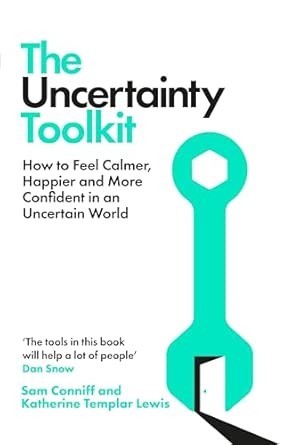
The Uncertainty Toolkit,
by Sam Conniff and Katherine Templar Lewis (Pan Macmillan, 2026)
Uncertainty is still too often treated as a temporary disruption, a failure of control, or an anomaly that will soon pass. That is the wrong interpretation. Uncertainty has become the new normal. The more you try to suppress it, the more you risk stiffening, overinterpreting, deciding too quickly, or freezing. The real issue is not uncertainty itself, but the way you respond to it. That response shapes the quality of your decisions, your capacity to learn, your openness, your creativity, and your ability to remain in motion when nothing is set in stone. The rare skill is no longer the ability to predict everything. It is to move through the unknown without losing either your discernment or your momentum.
1 . Why uncertainty unsettles you so deeply
- Uncertainty first activates the body and fear
Uncertainty is not only an intellectual problem. It is first and foremost a bodily and emotional experience. Before reason has time to organize things, your alert system switches on. Something tightens. Your mind searches for a fixed point. This is why uncertainty can so quickly degrade presence and judgment, even in highly competent people. You are not reacting with ideas alone. You are reacting with a body that is trying to protect itself. That difference matters. On uncertain ground, you are not entering a simple exercise in analysis. You are entering a situation that mobilizes survival reflexes, vigilance, and the need for safety.
- It feeds the worry loop, avoidance, and overreaction
From there, doubt does not remain neutral. It circles. It repeats. It becomes what we might call a worry loop: you worry about uncertainty, then you worry about your own worry. This spiral drives you to seek immediate relief. You may overreact, postpone, practice avoidance, retreat into routines, tighten control, or rush toward answers that are too quick. The mind wants to escape the fog not because it has already understood, but because it cannot tolerate the tension. This is how false certainties are born: not as signs of mastery, but as psychological sedatives.
- The real issue: your intolerance to uncertaintyWhat weakens you is not uncertainty itself, but a low tolerance for it. When your uncertainty tolerance is low, anxiety rises quickly, your field of vision narrows, and you reflexively fall back on reassuring answers.
When you tolerate uncertainty better, you remain more curious, more adaptable, and more able to learn. The point is not to make the uncertain disappear, but to become stable enough not to be immediately trapped by it. This is a major shift in perspective. The question is no longer, “How do I quickly return to a perfectly readable world?” It becomes, “How do I keep moving with clarity when nothing is fully readable?”
2. First shift: From fear to action
- Understand the emotional mechanics
As long as fear remains underground, it is in the driver’s seat. It appears in the guise of impatience, control, perfectionism, agitation, irritability, and sometimes even apparent coldness. Many people still believe the right posture is to show nothing, remain impeccably rational, and contain emotions. In reality, a bottled-up emotion does not disappear. It acts behind the scenes and distorts your relationship with reality. The first shift is therefore to notice what is happening inside you before it turns into automatic behavior. Not to endlessly self-monitor, but to prevent emotion from making the decision in your place.
- Regulate rather than deny
The goal is not to become a cold fish. It is to stop being unwittingly governed by emotions. Emotional regulation means slowing down the automatic reaction, creating inner space, and turning raw energy into available energy. You do not feel less. You feel more accurately.This changes everything. A regulated fear no longer paralyzes; it informs. It stops being an inner command and becomes a signal to interpret. That nuance is essential because it helps you escape the sterile choice between being overwhelmed and pretending not to feel anything. You do not have to choose between being invaded by emotion and denying it. You can learn to move through emotion without being governed by it.
- Turn fear into usable energy
The right course of action does not emerge from the absence of fear. It emerges from a more mature relationship with fear. As long as you interpret discomfort as proof that you should stop, you retreat. When you understand that discomfort may also signal a threshold to cross, something shifts. This is especially true in moments of exposure, transition, role change, or difficult decision-making. The real question is not, “How do I stop being afraid?” It is, “How do I keep moving without being constrained by fear?”Uncertainty then stops being a verdict on your self-worth and becomes a training ground for inner strength.
3. Second shift: from fog to agility
- Free yourself from biases and mental shortcuts
Once fear is better regulated, another issue appears: mental fog. When data is incomplete, shifting, or contradictory, your mind does not spontaneously become sharper. It mainly tries to escape discomfort. It fills in the blanks, applies old patterns to new situations, simplifies, and jumps to conclusions. The real danger of fog is not only that you cannot see clearly. It is that you believe you see clearly too quickly. Many errors of judgment do not come from lack of intelligence, but from a brain in a hurry to escape ambiguity.
- Observe your ability to think
Observing your own thinking — metacognition — is a decisive discipline. It means distinguishing what you know, what you assume, what you project, and what fear makes you conclude too quickly. It creates distance between your first interpretation and reality, thus making you more agile. It does not slow you down unnecessarily; it mostly prevents you from moving fast in the wrong direction. In an environment saturated with signals, opinions, analysis, and urgency, this ability to “think about your thinking” becomes one of the most precious tools for not confusing speed with clarity.
- Stay open under pressure
Mental agility does not mean hesitating forever, nor does it mean deciding and closing the case too early. It means keeping several hypotheses alive, revising your judgment as reality responds, and remaining open without dissolving. This is why open-mindedness matters so much. It is not a polite attitude or a moral extra. It is a factor in discernment. Under stress, we all become more narrow-minded, more rushed, more tempted to conclude. The real work is to notice when you are less open, when you are judging too quickly, and under what conditions you recover a more flexible state of mind. The more you know how to recreate that state, the better your decisions become.
- Decide better when nothing is stabilized
Ultimately, thinking in conditions of uncertainty requires less of a brilliant answer than a more appropriate mental stance. It means tolerating a degree of incompleteness without jumping to conclusions. It means accepting that a hypothesis remains a hypothesis, that intuition can be useful without immediately becoming certainty, and that an opinion becomes stronger when it can be revised. This flexibility is not softness. On the contrary, it is one of the most demanding forms of clarity. It requires you to stay present to reality, not to the reassuring image you wish it would take.
4. Third shift: From stasis to connection
- Recover motion, intuition, and meaning
There is a third, quieter obstacle: stasis. It is the moment when you are not only worried or confused, but stuck. Momentum disappears. Choices get bogged down. Motion itself seems out of reach. We call it fatigue, loss of motivation, or dispersion. But behind those words often lies something deeper: a broken connection with what used to propel you. When uncertainty becomes too dense, you can lose direction, confidence, and the feeling that action still has meaning.
- Reconnect brain, body, and attention
To escape stasis, it is not enough to add more reasoning. You also need to return to a fuller form of mindfulness. You do not think only with your head. You also think with a body, a rhythm, a level of tension, and a quality of attention. When all of that is saturated, even a good analysis loses traction. This is where embodied cognition matters: the simple but powerful idea that intelligence cannot be reduced to an abstract brain operation. Your perception, intuition, and ability to sense whether a decision feels right or wrong also depend on your physical and attentional state. If your body remains on alert, your mind overinterprets. If your attention is fragmented, your judgment loses depth.
- Return to what connectsAnother way out of stasis is connection. Connection to yourself, your internal signals, and your intuition. Connection to others, to trust, to quality of presence, and to the possibility of not moving through destabilization alone. Connection, finally, to something broader: a reason to move forward, a direction, a form of meaning. When these connections return, motion becomes possible again. You do not necessarily have more information than before. But you once again have enough support to restart. Connection is not a comfortable add-on. It is a condition for renewed motion. It turns inertia into momentum because it restores what allows you to inhabit uncertainty without feeling cut off from yourself.
You will not escape uncertainty. But you can escape the sterile way you sometimes enter it: through tension, overreaction, or paralysis. This is where the decisive skill now lies. Less in demonstrative certainty than in the quality of presence. Less in absolute control than in the ability to remain calm, open, and connected when reality resists. In the end, the dividing line is simple: there are those whom uncertainty constrains, and those whom it drives to become more lucid, more agile, and more alive. That is where the leadership that matters will be played out.
© Copyright Business Digest - All rights reserved