Creating moments that impact employee experience
Flashes of insight, crowning achievements, and connections with others are the kinds of moments that make up extraordinary employee experience. As a leader, do you invest in creating such defining moments for yourself and your teams, or do you just leave them to chance?
80% of executives today rate employee experience (EX) as very important or important. Despite it being a top leadership priority, however, only 22% report that their companies have achieved excellence in it. When it comes to addressing this gap, nearly 60% say they do not feel ready or even somewhat ready to do so. Do you, like so many other leaders, recognize the importance of building standout employee experience but feel unsure where to start? In The Power of Moments, the Heath brothers (the duo behind The New York Times bestsellers Decisive, Switch, and Made to Stick) outline a compelling, concrete approach to employee experience: invest more in the moments that profoundly shape employee perceptions. “Research has found that in recalling an experience, we ignore most of what happened and focus instead on a few particular moments,” they write, noting that this fact is widely overlooked. By identifying what characterizes “defining moments,” you as a leader — and here comes the hard part — can work to create more of them for yourself and your teams: “Defining moments shape our lives, but we don’t have to wait for them to happen,” the Heaths argue. “We can be the author of them.”
Why you should “think in moments”
The attainment of shared goals is what brings your teams together and keeps them aligned. But have you ever asked yourself if focusing too much on goals is blinding you to other — more human — performance factors? “In organizations, we are consumed with goals. Time is meaningful only insofar as it clarifies or measures our goals. The goal is the thing,” note the Heaths. “But for an individual human being, moments are the thing. Moments are what we remember and what we cherish.” Try considering your goals in terms of moments. When your teams achieve a goal, how much do you typically invest in making it as meaningful and memorable a moment as possible?
This is the challenge thrown out by the Heath brothers: to create the kind of moments that make for extraordinary employee experience. In the Heaths’ words, “This is what we mean by “thinking in moments”: to recognize where the prose of life needs punctuation.” Learning to think in moments, to spot the important ones and make them count, will push you to enrich your teams’ experiences, forge stronger connections, and launch them in new directions.
When it counts “to think in moments”
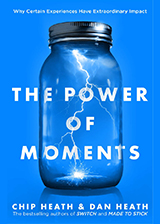 We crave landmarks for transitions, hence the human need for coming-of-age rituals, graduations, and weddings. As the Heaths write, “When a life transition lacks a ‘moment,’ it can become formless.” This is why transitional moments are important to spot and mark with your teams. At the American manufacturing giant John Deere, for example, Global Brand Director Lani Lorenz Fry used the power of moments to tackle a problem with employee engagement and retention due to lack of emotional connection in Asia with the company’s American brand. Fry worked with a customer experience consultant to co-design a meaningful, impactful framework for first days on the job, called “The First Day Experience.” By creating an emotional connection with employees right from their first day, the program has increased engagement and retention and is now being rolled out across all of John Deere’s Asian offices: “(It) has helped to differentiate John Deere in a highly competitive labor market.” Milestones should be commemorated. In most organizations, the celebrations for milestones like retirement “tend toward the mundane,” but “deserve so much more.” The Heaths also emphasize the potential to make more of your teams’ “unheralded achievements”: “We celebrate employees’ tenure with organizations, but what about their cumulative accomplishments?” they ask. “Isn’t a salesman’s 10 millionth dollar of revenue earned worth commemorating? Or what about a talented manager who has had 10 direct reports promoted?”
Excerpt from Business Digest N°280, October 2017
Based on The Power of Moments by Chip Heath and Dan Heath (Simon & Schuster, October 2017).

© Copyright Business Digest - All rights reserved