
How can you make reframing a problem more acceptable ?
The process for reformulating and reframing a problem is long and demanding, and sometimes runs counter to entrenched beliefs, generating denial or even outright resistance. Here are a handful of tips for tackling such a reaction.
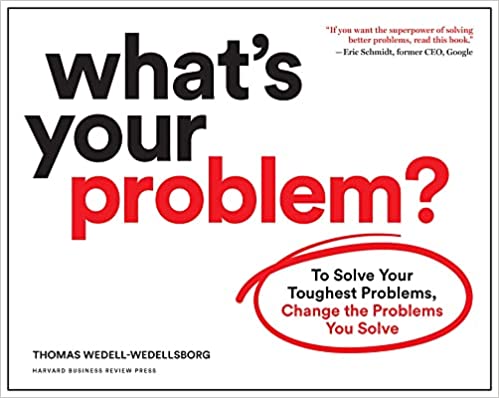
What’s Your Problem? : To Solve Your Toughest Problems, Change the Problems You Solve, by Thomas Wedell-Wedellsborg, (Harvard Business Review Press, march 2020)
1/ CREATE FERTILE GROUND FOR REFRAMING A PROBLEM
Do you want to make sure that the true nature of a problem isn’t giving your team the slip? If so, you need to set up a reframing session to check that every angle has been taken into account. For more experienced professionals, however, the prospect of devoting time to reframing a problem isn’t the least bit attractive. That’s why it’s in your best interest to prepare the ground meticulously.
- Before starting discussions, invite each participant to formulate how they see the problem in writing without suggesting your own vision in advance. The discrepancies (even the smallest) you’ll discover on reading their contributions will be an effective way of underlining the importance of this type of discussion.
- Take the time to explain the concept of reframing and to show its potential benefits by recounting a few choice anecdotes: the tale of the slow elevator and the impatient visitors is a sure bet!
2/ STRUCTURE YOUR DISCUSSION TO CLARIFY THE PROBLEM
Reframing isn’t as simple as: “I don’t think we’re focusing on the right subject.” It’s a bona fide approach with pre-defined steps. Don’t be afraid to structure your discussions using a framework presented in the form of a table that can be completed by all the participants together:
- What? The initial formulation of the problem.
- Who? A list of involved or concerned stakeholders and their role in the problem. Don’t leave yourself out of the equation.
- When, where and why? Explore the current context and the previous situation: what has changed in the meantime and why, and what information could have a hidden influence?
- Filter the most frequent cognitive biases: confirmation bias (the tendency to search for information that confirms a prior opinion) and belief bias (the tendency to judge the strength of arguments based on the plausibility of their conclusion); the halo effect (when the positive perception of a group or person in one area positively influences one’s opinions in other areas); illusory correlation (the perception of a relationship between variables even when none exists); etc.
- Look for positive exceptions.
3/ TAILOR YOUR WORDS TO YOUR AUDIENCE
The way we understand trials and ordeals is greatly influenced by our mental construction. Consider adopting language that your employees will be most receptive to.
- Motivation theorist Edward Tory Higgins distinguishes two categories of behavior when faced with a particular scenario: there are people who see the situation as a potential loss, and those who see it as a potential gain. For the former, you will have to present the reframing as the best way to avoid committing an unfortunate error. The latter, conversely, will be more motivated if you suggest that a deeper examination of the problem can only have beneficial consequences.
- Another motivation expert — Arie Kruglanski — has studied the need for closure, which refers to the desire to arrive at a solid answer to a question. Someone with a very strong need for closure will tend to regard analyzing a difficulty as a waste of time that only postpones the solution. This individual will be sensitive to discourse that presents reframing as a move towards action. On the other hand, some individuals avoid closure and risk indulging in analyzing the problem ad infinitum. Faced with the latter, you will have to make sure you stick to a precise timeframe, even if it means giving them missions they like (such as data research).
4/ DEAL WITH DENIAL
Despite your best efforts, maybe your employees (or your customers or partners) don’t see the point of challenging the way they approach a problem, and prefer to pursue the proposed solutions. Here again, you’ve got a new problem to reframe.
- Apply the same method as with any other complex type of problem: rather than starting with a preconception (“They don’t understand that they risk disaster”), begin by asking yourself if you’ve read their attitude properly. Their resistance to the reframing may actually be a sign of anxiety about the future or of a lack of confidence in you. It may also quite simply indicate that the team is self-assured. In this case, you would be well advised to take a look at your own beliefs: what makes you think you’re right in spite of everything? What goal are you really pursuing via this reframing?
- Take the heat out of discussions: don’t hesitate to bring in someone neutral who can act as a mediator between those who are for and those who are against the reframing, thereby helping the group to reach common ground. In the same vein, concentrate on factual data rather than getting involved in heated arguments.
- Don’t get hung up on your beliefs: faced with employees who are rallying around each other in denial, you can still win them over by presenting two separate action plans: one based on the vision of the status quo, and the other on reframing this vision. This parallel perspective of the two options may perhaps help some individuals change their outlook.
© Copyright Business Digest - All rights reserved


© copyright Business Digest, tout droit réservé